
Teach · Educator guide
Islands in the Sky: Educator Guide
Everything you need to teach A People’s History of Hurricane Helene, from one story in one class period to a three-week unit.
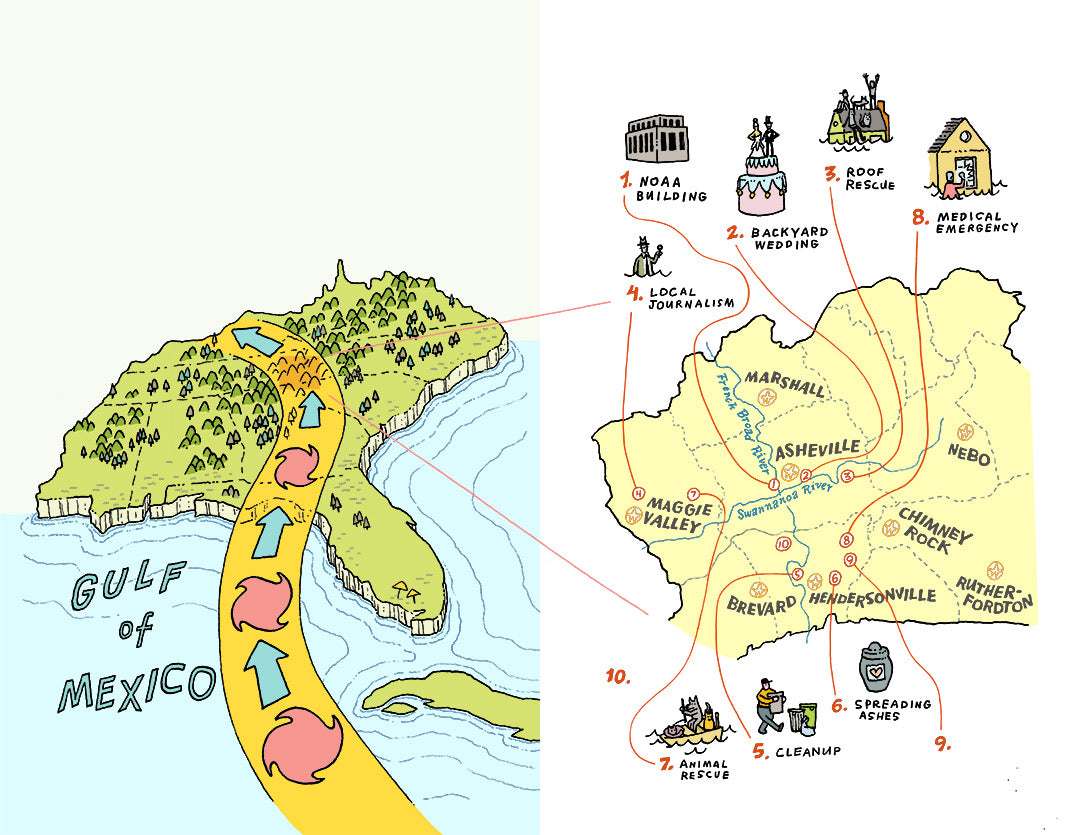
Start here
Where the stories happened
Project the story map on day one so students can place each story as they read.
At a glance
- Grades
- 6–12, college
- Subjects
- ELA, social studies, earth science, civics, art
- Time
- 1 period to 3 weeks
- Length
- 144 pages, 11 stories
- Format
- Full-color graphic nonfiction
- Content notes
- Death, injury, loss, displacement
What the book is. Islands in the Sky collects eleven true stories from Hurricane Helene, which struck Southern Appalachia in September 2024. Each story is told by a person who lived through the storm and drawn by a professional comics creator, including Brian Michael Bendis, Matt Fraction, Gene Luen Yang and Nate Powell.
Why teach it. The book lets students study a recent disaster through primary-source testimony, practice reading images as evidence, and ask a question that matters for every future crisis: who gets to tell the story?
Essential questions
- What do we learn from a disaster when it is told by the people who lived it?
- How do words and images work together to carry memory and emotion?
- What makes a community resilient, and what does recovery actually take?
Teaching with care
Some of your students may have lived through Helene, or through another disaster. Preview every story before assigning it, and read the notes below.
- Choose stories deliberately. Start with stories about community response and mutual aid before stories involving loss of life.
- Offer choice. Let students pick from two or three stories, and provide an alternate assignment without requiring an explanation.
- Don’t require personal disclosure. Students can write about a family member, a community, or the book itself instead of their own experience.
- Close each session. End with a grounding activity: a strength noticed, an act of help, a question for tomorrow.
- Loop in support. Let your school counselor know when the unit begins, and share local mental-health resources with families.
How to read a comics page
Give students this vocabulary before reading. It turns “looking at pictures” into close reading.
- Panel
- A single frame showing a moment
- Gutter
- The space between panels, where the reader fills in time
- Caption
- Narration in a box, often the survivor’s voice
- Balloon
- Dialogue or thought spoken in the moment
- Splash
- A full-page image used for emphasis
- Bleed
- Art running off the page edge, removing the frame
Lesson sequence
A flexible three-week plan. Each week also stands alone.
Week 1: Before the storm, and reading comics
- Hook. Show a news photograph of flood damage, then a single page from the book. What does each one let you understand?
- Vocabulary. Teach the six terms above with a projected page.
- First story. Read one story together, pausing at three gutters to ask: what happened here that we didn’t see?
Week 2: The stories, and the science
- Literature circles. Small groups each take one story and prepare a 5-minute presentation on its narrator, turning point and one key panel.
- Data pairing. Match each group’s story to a place on a map of rainfall totals and landslides. How does the data explain what the narrator experienced?
- Perspective study. Compare one story with a news article about the same community.
Week 3: Telling stories ourselves
- Oral history workshop (below).
- Comic creation. Students thumbnail and draw a one-page comic from their interview. Stick figures are welcome; storytelling is the skill.
- Gallery walk and reflection.
Discussion questions
Labels show the thinking each question asks for: Recall Analyze Connect
- Recall What was the first moment the narrator realized the storm was different from others they had seen?
- Analyze Find a panel with no words. What does it communicate that words could not?
- Analyze How does the artist use color to show the passage of time, or a change in mood, across the story?
- Analyze Captions are often in the survivor’s own voice. How would the story change if a narrator outside the event told it?
- Connect The book is called Islands in the Sky. Why might mountain towns have felt like islands after the storm?
- Connect Many stories show neighbors helping before official help arrived. What made that possible?
- Connect If a disaster happened in your community, whose stories would be most likely to be left out of the record?
Activities
Six-panel emergency plan
Students draw a six-panel comic showing their household’s plan: where to meet, who to call, what to pack, how to get water. Because comics work without power or signal, the finished page can live on the fridge.
Read the river
Show the NOAA hydrograph for the French Broad River at Fletcher (gauge FLCN7). Flood stage is 13 feet and the previous record was 20.1 feet; Helene pushed it to 30.31 feet. Students mark the crest, then find the moment in a story that matches it.
The gutter challenge
Give pairs two panels from the book with the middle panel removed. Each pair draws the missing moment, then compares it with the original.
Two accounts
Students read a news article and a comic about the same community, then complete a T-chart: facts both include, details only one includes, and whose voice is centered.
Oral history workshop
Every story in the book began as an interview. This two-day workshop gives students the same process.
- Prepare. Write five open questions (“Tell me about…”, “What do you remember about…”). Practice on a partner.
- Interview. Record 10–15 minutes with a family or community member, with their permission. The topic doesn’t have to be a disaster; any turning point works.
- Select. Transcribe the most important two minutes and underline the moment of change.
- Script. Break that moment into four to six panels: what we see, what the caption says, what anyone says aloud.
- Return it. Share the finished page with the person interviewed. This is the most important step.
Standards alignment
| Standard | What students do |
|---|---|
CCSS RI.8.7 |
Evaluate the advantages and disadvantages of different media for presenting a topic (news article vs. comic). |
CCSS RL.9-10.7 |
Analyze how a subject is represented in two different artistic mediums. |
CCSS W.9-10.3 |
Write narratives of real experiences using effective technique (oral history comic). |
C3 D2.His.4.9-12 |
Analyze factors that shaped the perspectives of people during an event. |
NGSS MS-ESS3-2 |
Analyze data on natural hazards to inform mitigation (rainfall and landslide maps). |
NGSS HS-ESS3-1 |
Explain how natural hazards have influenced human activity. |
FAQ
What grade level is the book appropriate for?
The guide supports grades 6–12 and college. Some stories depict death, injury and loss; teachers of younger students should preview stories and use the selection notes above.
How long does it take to teach?
A single story can be taught in one or two class periods. The full sequence runs one to three weeks.
Can I get a class set?
Yes. Contact us for class-set and library pricing.